

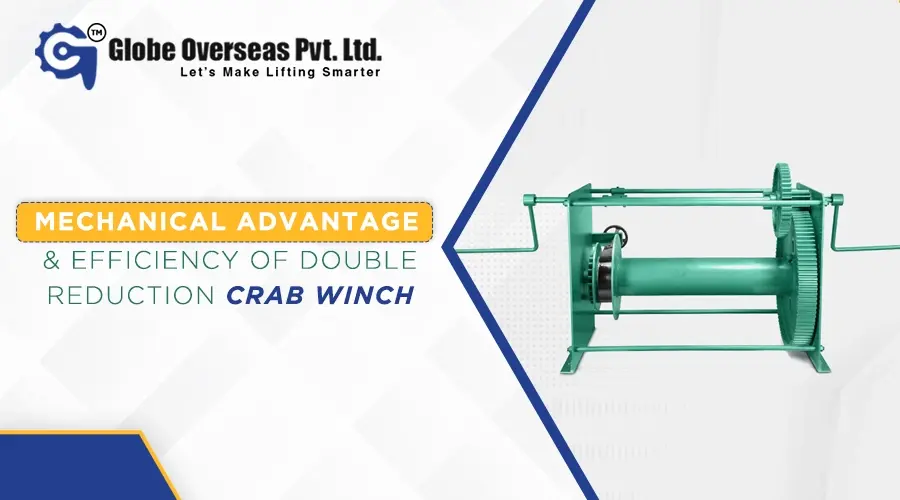
Material handling plays a vital role in industries such as construction, manufacturing, mining, marine, warehouses, and heavy engineering. Among the many lifting and pulling devices used in these sectors, the Double Reduction Crab Winch is known for its ability to lift and pull heavy loads with greater control and reduced manual effort. Its robust construction and gear-driven mechanism make it a preferred choice for applications requiring precision, durability, and high load-handling capacity.
Two of the most important factors that determine the performance of a double reduction crab winch are mechanical advantage and efficiency. Mechanical advantage explains how effectively the winch multiplies the operator’s input force, while efficiency measures how much of that input energy is converted into useful work after accounting for friction and mechanical losses.
Understanding these concepts helps engineers, maintenance teams, and buyers select the right winch for specific applications while ensuring safe and economical operation. This article explores the mechanical advantage and efficiency of double reduction crab winches, including their working principle, influencing factors, advantages, and methods for improving performance.
What is a Double Reduction Crab Winch?
A Double Reduction Crab Winch is a manually operated lifting and pulling device that uses two stages of gear reduction to increase torque while reducing the effort required to move heavy loads. Unlike a single reduction winch, the double reduction design provides a higher gear ratio, enabling operators to handle significantly heavier loads with greater precision.
The winch generally consists of:
-
Steel frame
-
Gear train with double reduction
-
Winding drum
-
Handle or crank
-
Shaft
-
Bearings
-
Ratchet and pawl mechanism
-
Brake system (in some models)
-
Wire rope or cable
The two-stage gear arrangement provides smoother operation and greater lifting capability without requiring excessive manual force.
Working Principle
The operation of a double reduction crab winch is based on the principle of mechanical power transmission through gears.
When the operator rotates the handle:
-
The crank applies input force.
-
The first gear reduces speed while increasing torque.
-
The second reduction stage further multiplies torque.
-
The drum rotates slowly.
-
The wire rope winds around the drum.
-
The load is lifted or pulled safely.
This arrangement enables the operator to lift loads several times greater than the force applied at the handle.
Understanding Mechanical Advantage
Mechanical Advantage (MA) refers to the ratio of the output force produced by the machine to the input force applied by the operator.
Formula
Mechanical Advantage = Load Lifted / Effort Applied
For example:
-
Load = 1000 kg
-
Operator effort = 25 kg
Mechanical Advantage = 1000 ÷ 25 = 40
This means the winch multiplies the operator’s effort by forty times.
The higher the mechanical advantage, the less physical effort is required to move the load.
Why Double Reduction Increases Mechanical Advantage
The key feature of a double reduction crab winch is its two-stage gear system.
Each gear reduction multiplies torque.
For example:
-
First reduction = 5:1
-
Second reduction = 4:1
Overall gear reduction:
5 × 4 = 20:1
This means the drum rotates once for every twenty turns of the crank while significantly increasing torque.
As torque increases, the operator can move heavier loads with less effort.
Factors Affecting Mechanical Advantage
Several factors influence the mechanical advantage of a double reduction crab winch.
1. Gear Ratio
Higher gear ratios increase torque while reducing the required input force.
A larger gear reduction generally results in:
-
Easier lifting
-
Better load control
-
Slower drum speed
-
Greater lifting capacity
2. Handle Length
A longer crank handle increases leverage.
Greater leverage means:
-
Lower operating effort
-
Improved control
-
Reduced operator fatigue
However, excessively long handles may not be practical in confined spaces.
3. Drum Diameter
The drum diameter affects the amount of torque required.
A smaller drum requires less torque but winds less cable per revolution.
A larger drum increases lifting speed but demands greater effort.
4. Load Weight
As load weight increases, the operator must apply more effort unless compensated by higher gear reduction.
Proper winch selection ensures safe handling within the rated capacity.
5. Rope Condition
Damaged or improperly wound wire rope can increase resistance and reduce the effective mechanical advantage.
Regular inspection helps maintain smooth operation.
Understanding Efficiency
Efficiency measures how effectively a machine converts input energy into useful output work.
Formula
Efficiency (%) = (Mechanical Advantage ÷ Velocity Ratio) × 100
Efficiency is always less than 100% because some energy is lost through:
-
Friction
-
Bearing resistance
-
Gear contact
-
Rope bending
-
Lubrication losses
For most manually operated double reduction crab winches, efficiency depends heavily on maintenance and operating conditions.
Factors Affecting Efficiency
Gear Friction
Every gear mesh creates friction.
Although precision-machined gears reduce losses, some energy is always dissipated as heat.
Bearing Quality
High-quality bearings reduce rotational resistance.
Poor bearings increase effort and reduce efficiency.
Lubrication
Proper lubrication minimizes friction between:
-
Gears
-
Bearings
-
Shafts
Insufficient lubrication leads to wear and increased operating effort.
Alignment
Misaligned shafts or gears create additional resistance.
Correct alignment improves smoothness and reduces energy loss.
Load Distribution
Operating near the rated capacity often provides better efficiency than running with excessively light or overloaded conditions.
Rope Condition
Properly maintained wire ropes reduce friction during winding and unwinding.
Damaged ropes increase resistance and wear.
Relationship Between Mechanical Advantage and Efficiency
Mechanical advantage and efficiency are closely related but represent different aspects of performance.
-
Mechanical advantage indicates how much the operator’s force is multiplied.
-
Efficiency indicates how effectively the winch converts that input into useful work.
A winch can have a high mechanical advantage due to its gear reduction while still experiencing reduced efficiency if friction, poor lubrication, or wear are significant. Well-designed and properly maintained winches achieve a practical balance between high mechanical advantage and good efficiency.
Advantages of High Mechanical Advantage
A double reduction crab winch with high mechanical advantage offers several benefits:
-
Reduced manual effort
-
Safer load handling
-
Better control during lifting
-
Increased lifting capacity
-
Lower operator fatigue
-
Smooth movement of heavy equipment
-
Improved positioning accuracy
These advantages make the winch suitable for repetitive heavy-duty operations.
Benefits of High Efficiency
Efficient operation delivers value through:
-
Lower energy losses
-
Reduced wear on gears and bearings
-
Longer equipment life
-
Lower maintenance costs
-
Smoother operation
-
Consistent performance
-
Improved productivity
Maintaining efficiency also contributes to workplace safety by ensuring predictable load handling.
Industrial Applications
Double reduction crab winches are widely used in:
Construction
-
Lifting building materials
-
Moving structural components
-
Positioning equipment
Manufacturing
-
Machine installation
-
Production line maintenance
-
Heavy component handling
Warehouses
-
Material movement
-
Equipment positioning
-
Storage operations
Marine Industry
-
Dock operations
-
Boat handling
-
Cargo movement
Mining
-
Equipment maintenance
-
Underground material handling
-
Machinery positioning
Power Plants
-
Turbine maintenance
-
Heavy equipment installation
-
Mechanical servicing
Improving Mechanical Advantage and Efficiency
Operators can maximize performance through proper maintenance and operation.
Recommended practices include:
-
Lubricate gears and bearings regularly.
-
Inspect wire ropes for wear or damage.
-
Replace worn gears promptly.
-
Keep the drum clean and free of debris.
-
Ensure proper gear alignment.
-
Avoid overloading the winch.
-
Perform routine inspections of the brake and ratchet mechanisms.
-
Use genuine replacement parts.
-
Train operators in correct handling techniques.
These practices help preserve both mechanical advantage and overall efficiency.
Choosing the Right Double Reduction Crab Winch
When selecting a winch, consider:
-
Required load capacity
-
Lifting or pulling application
-
Gear ratio
-
Rope length and diameter
-
Drum size
-
Build quality
-
Safety features
-
Operating environment
-
Maintenance requirements
-
Manufacturer reputation
Selecting a winch that matches operational needs ensures reliable performance and long service life.
Conclusion
The Double Reduction Crab Winch is an efficient and dependable solution for lifting and pulling heavy loads across a wide range of industrial applications. Its two-stage gear reduction system provides a high mechanical advantage, enabling operators to handle substantial loads with less manual effort while maintaining precise control. Although no mechanical system is perfectly efficient due to unavoidable friction and wear, proper design, quality components, and regular maintenance help maximize performance and extend equipment life.
By understanding the relationship between mechanical advantage and efficiency, businesses can make informed decisions when selecting and maintaining crab winches. Investing in a well-engineered double reduction crab winch not only enhances productivity but also promotes safer operations, reduced operator fatigue, and long-term cost savings, making it a valuable asset for demanding material handling tasks.
- April 5, 2022
- By:admin
- Category:Crab Winch
- Tags: Advantage of Double Reduction Crab Winch, Crab Winch, Double reduction Crab Winch, electric winch machine, Worm Gear Hand Winch
- no comments
Related Posts
- February 20, 2025
- By: admin
- in: Crab Winch